The Unofficial Rules of an Italian Kitchen
Growing up, I didn't just have one Italian kitchen.
I had many!
On one side was my grandmother Antoinette and my mother MaryAnn.
On the other side was my father's family, a full Sicilian household led by my grandmother Lily.
With Lily came five daughters and one very outnumbered son, my father.
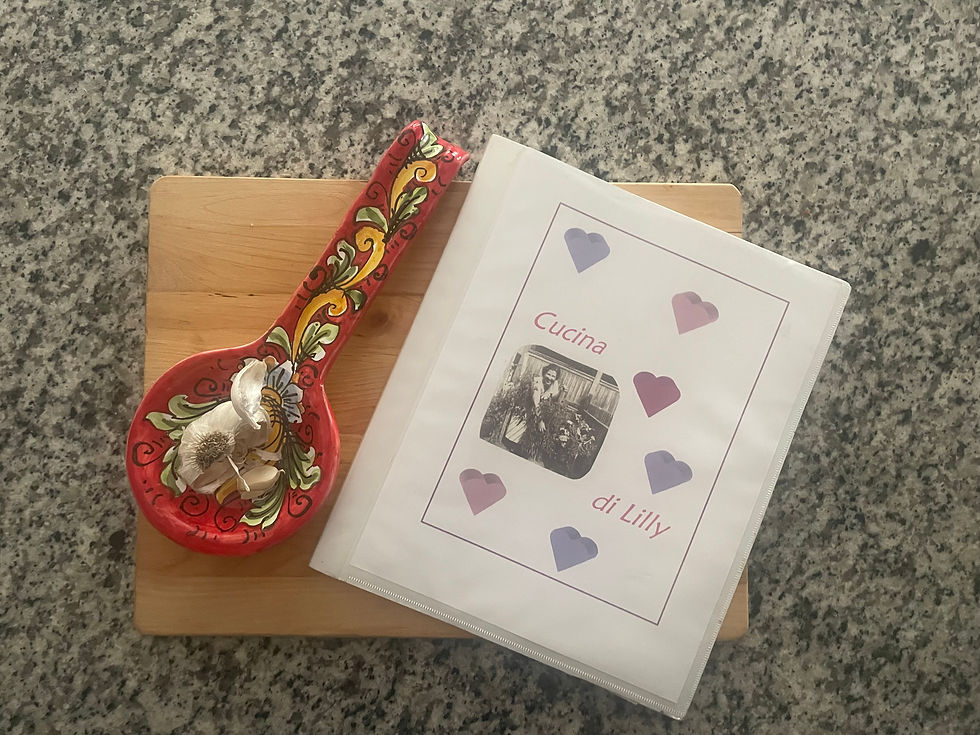
Food was such a central part of that family that they eventually compiled and distributed a family heirloom cookbook called Cucina di Lily.
Yes, I have a copy.
No, I still can't cook like her.
With five Sicilian aunts, a grandmother who deserved her own cookbook, and a mother who could feed an army on short notice, I somehow developed a different specialty:
Cleanup.
My husband would probably confirm this.
Add in all the cousins, and there were enough of us to start our own football team, complete with substitutes.
Forget about the holidays when both sides got together.
At that point, we weren't hosting dinner.
We were managing a small Italian convention.
Food wasn't something we ate.
Food wasn't even dinner.
It was the Italian Olympics, complete with multiple rounds, fierce competitors, family judges, and absolutely no option to withdraw once your plate was full.
Participation was mandatory.
It was a committee meeting.
A love language.
A family reunion.
A therapy session.
A five-hour event disguised as lunch.
And if you grew up in an Italian family, you already know there were rules.
Not written rules.
Kitchen rules.
The kind passed down through generations without anyone ever explaining them.
Somehow, everybody just knew.
Rule #1: Nobody Leaves Hungry
This was not a suggestion.
This was family law.
Rule #2: Everyone Is Feeding You
One Italian woman with a spoon is a challenge.
Six Italian women with spoons is an organized operation.
Rule #3: "I Already Ate" Means Nothing
In fact, saying you already ate only creates concern and additional food.
Rule #4: Somebody Is Always Making Sauce
Every visit seemed to involve a pot simmering somewhere.
Nobody questioned it.
That's just how life worked.
Rule #5: Every Conversation Leads Back to Food
The conversation may begin with:
work
school
family news
the kids
politics
Depending on which political theory my father was testing that day, you might find yourself reaching for a second cannoli purely for emotional support.
The grown-ups had opinions on everything.
The rest of us had pasta and survival instincts.
Within minutes someone will ask:
"Did you eat?"
And we're back where we started.
Rule #6: The Kitchen Table Was the Real Living Room
The television was decoration.
Life happened in the kitchen.
Stories.
Arguments.
Laughter.
Tears.
Advice.
Espresso.
Cookies.
Family history.
Uno.
Scopa.
Everything important happened around that table.
Rule #7: Everyone Had an Opinion
Especially if it wasn't their recipe.
There was always somebody explaining how they would have made the sauce.
Or why Aunt So-and-So's braciole was better.
Or why the eggplant parmigiana tasted different this year.
Nobody was asked.
Opinions were provided anyway.
Rule #8: Never Insult the Cook
That said, there was one line nobody crossed.
You never insulted the cook.
You could debate politics. (kind of. )
You could argue about who called whom last.
You could spend an hour discussing the neighbors, bingo night, or whatever scandal happened around the pool that week.
But if someone spent all day cooking for twenty people, you ate the food, complimented the food, and took leftovers home.
Lots of leftovers!
In fact, my friends somehow always knew when we'd just gotten home from a family gathering.
They'd show up at the front door within the hour.
Coincidence?
I think not.
There was always extra food.
That wasn't etiquette.
That was survival.
Then near the end:
Growing up between Antoinette's kitchen, MaryAnn's kitchen, and my father's loud, loving Sicilian family, I learned something important.
Food was never really the point.
The people were.
The recipes were just the excuse to gather them together.
Looking back, some of my favorite memories weren't the meals themselves.
They were the people standing around the stove, arguing over whose recipe was better while secretly using the exact same ingredients.
Today, when I watch my oldest son creating in the kitchen, I see the same thing.
Different generation.
Different kitchen.
Same family story.
The same love expressed through feeding the people around you.
And if you're wondering who started the argument over whose meatballs were better...
Don't blame me.
Blame MaryAnn™.



I didn't expect a post about Italian kitchens to make my day, but it did. Reading this felt like I was at the table. Thank you for the read!